
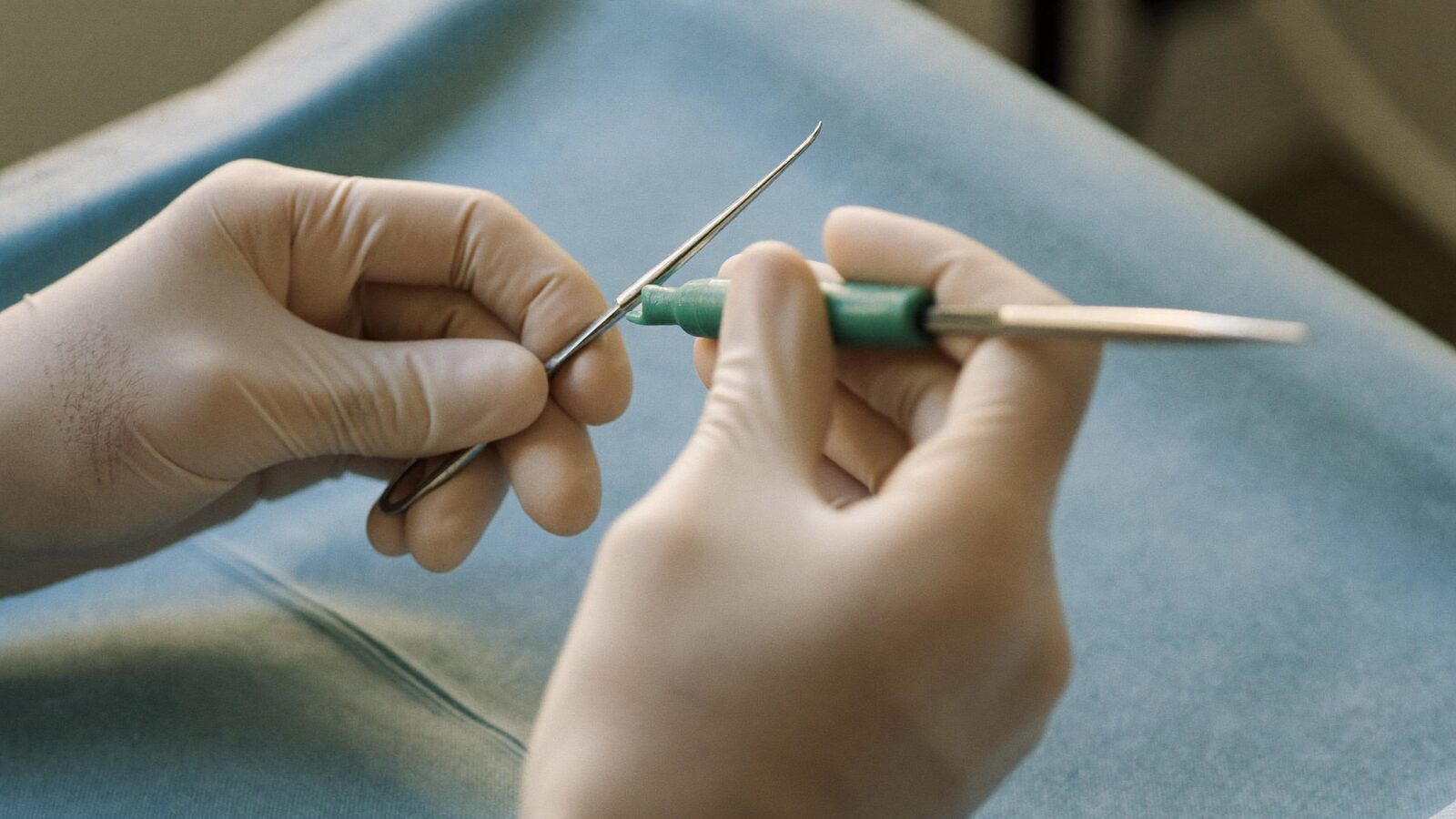
The short answer on manual vs robotic FUE: both remove follicles one at a time from the back of the scalp, but manual FUE uses a handheld punch guided by a trained technician, while robotic FUE uses an image-guided arm to choose and cut follicles. The skill and planning of the team usually shape the result far more than the machine does.
FUE (follicular unit extraction) has changed a lot over the last decade, mostly in quieter ways than the marketing suggests: finer punches, better graft handling and smarter donor planning. At our FUE clinic in Chicago, extraction is manual, done by hand with fine instruments by a full-time in-house team. This guide explains how each approach works, where each one struggles, and what to ask whichever clinic you visit.
Key takeaways
- Manual and robotic FUE both extract individual follicular units; they differ in who or what guides the punch.
- Robotic systems mainly automate the extraction step; hairline design and graft placement still depend on people.
- Transection, meaning a follicle cut during removal, is the key quality measure for any extraction method.
- Curly hair, very fine hair and tight or scarred scalps usually call for the hand adjustments manual FUE allows.
- The team's experience, donor planning and placement skill matter more than the device on the tray.
How manual FUE works
Manual FUE works by scoring around each follicular unit with a small handheld punch, usually under one millimeter wide, then gently lifting the graft out with forceps. The technician feels the resistance of the skin and changes angle and depth graft by graft, which helps keep each follicle whole.
A follicular unit is the natural group of one to four hairs that grows from the same spot. In manual FUE, the person holding the punch reads where those hairs sit under the skin, which is not always where they exit at the surface. Hairs often curve below the skin, so the punch angle has to follow that curve rather than the visible shaft.
Because the process is guided by hand and eye, the team can change approach mid-session: a slower rhythm in a zone where hair is finer, a different punch where the skin is firm, or a wider spacing where the donor area is thinner. That ability to adapt is the main reason many experienced clinics still prefer it. Our step-by-step FUE protocol shows how extraction, graft storage and placement fit together on the day.
How robotic FUE works
Robotic FUE works by photographing the donor area, using software to pick follicular units that meet set criteria, and guiding a mechanical arm to score and loosen each one. A clinician supervises, adjusts settings and still removes and sorts the loosened grafts, so the robot handles one step rather than the whole procedure.
The appeal is consistency. A machine does not get tired, and its software can space extractions in a regular pattern. On straight, dark hair against light skin, where the camera can read the follicles clearly, that consistency can work well.
The limits appear when hair is harder to read. Gray or very light hair, curly hair whose root bends sharply, and dense or scarred skin can confuse the imaging or the fixed punch path. Robotic systems also need a shaved donor area and a defined working field, which reduces flexibility for patients who want a less visible donor zone.
How has FUE technology changed over the years?
FUE technology has changed mostly through refinement rather than reinvention. Punches have become finer, often 0.7 to 0.9 millimeters, graft storage solutions keep follicles cooler and moist for longer, recipient sites are smaller, and donor planning now spreads extraction evenly to protect future sessions.
When FUE first spread in the 2000s, it was slow and transection could be high because tools were blunt and teams were still learning. Motorized and robotic devices arrived promising speed. Over time, many clinics found that the bigger gains came from training, handling and planning, not from automating the cut.
- Smaller punches: less tissue disruption and tiny dot scars that hide well under short hair.
- Better graft handling: chilled holding solutions and less time out of the body help grafts survive.
- Finer recipient sites: small incisions let grafts sit closer together at natural angles.
- Donor management: even spacing across the safe zone leaves reserve for later loss.
- Implanter pens: some teams place grafts with a pen-style implanter, an option explained in our DHI vs FUE guide.
One idea that has not held up is that newer automatically means better. A manual punch in experienced hands is not an outdated tool, and a device does not make up for weak planning. Several of these misunderstandings are unpacked in our list of common FUE myths and the facts behind them.
Graft quality and transection
Graft quality comes down to keeping the whole follicle intact, including the bulb at its base and a little protective tissue around it. Transection is when the punch cuts through a follicle during extraction. A transected graft may grow poorly or not at all, so low transection is the clearest sign of good extraction, whatever the method.
In manual FUE, the technician can feel when a punch is heading off-angle and correct it before the follicle is damaged. Robotic systems rely on the camera's reading of the hair's exit angle, which works when the hair runs straight below the skin and is less reliable when it curves.
Graft quality also depends on what happens after extraction. Grafts that dry out, sit at room temperature for long periods or get crushed during handling lose viability no matter how cleanly they were removed. That is why it makes sense to ask any clinic how grafts are stored, counted and checked, and not only how they are cut.
| Factor | Manual FUE | Robotic FUE |
| Who guides the punch | A trained technician, by hand and eye | Software and a mechanical arm, supervised by staff |
| Adjusting to curved roots | Angle and depth changed graft by graft | Limited to what imaging can read at the surface |
| Gray, light or curly hair | Generally workable with experience | Often harder for the camera to track |
| Hairline design and placement | Done by people | Also done by people in most setups |
| Main dependency | Team skill and consistency | Device settings plus team skill |
Hairlines, curly hair and tight scalps
Hairlines, curly hair and tight scalps are where the hands-on approach shows its value. A natural hairline needs fine single-hair grafts chosen carefully, curly hair needs a punch that follows a bending root, and a tight or scarred scalp needs constant pressure and depth changes. These are judgment calls rather than repeatable settings.
For the hairline itself, the device question is mostly irrelevant: in nearly every clinic, robotic or not, the design and placement are carried out by people. What changes is how the single-hair and finer grafts were selected at extraction. A technician sorting grafts by hand can set aside the softest ones for the front edge.
Curly and Afro-textured hair is a special case because the curl often continues below the skin. A straight punch path is more likely to cut it. Manual extraction with slower, adjusted technique tends to protect those grafts better, which our article on transplants for curly and Afro-textured hair covers in more depth.
Good to know: patients with old FUT strip scars or earlier FUE scarring often have firmer skin in the donor zone, which usually calls for hand-guided extraction and careful spacing.
Does robotic FUE cost more than manual FUE?
Robotic FUE often costs more than manual FUE, partly because the equipment and per-procedure fees are expensive for the clinic. That said, the price that matters to a patient is the total for the grafts in a written plan, and a higher fee for a device does not by itself mean more grafts that grow.
At our clinic, quotes are based on the number of grafts after a free assessment, with no session fees, so the cost follows the plan rather than the tool. Our hair transplant cost page explains the per-graft range and how financing works.
When comparing quotes from different providers, line them up by graft count, who does each step, and what follow-up is included. A cheaper or pricier quote only makes sense once those three are clear.
Which matters more: the device or the team?
The team matters more than the device. Robotic or manual, a hair transplant succeeds when the donor area is planned conservatively, grafts are extracted with low transection, handled gently, and placed at natural angles in a hairline that suits the face. Those steps depend on training, experience and oversight.
At Nova Medical Hair Transplant Chicago, Dr. Otto Placik reviews and approves every plan, designs the hairline with the patient and oversees the procedure, while a full-time team of licensed technicians with 25+ years of combined experience carries out manual extraction and placement. Nobody travels in for the day, and the same group works together on every case.
If a clinic leads its pitch with a machine, ask who actually operates it, who places the grafts and how many cases that team does each year. Those answers say more about your likely result than the brand of equipment.
- Who extracts the grafts: a device, a technician or both, and how experienced are they?
- How is transection checked: are grafts inspected and counted under magnification?
- Who designs the hairline: and will you see it drawn before anything starts?
- How is the donor area protected: what reserve is left for future loss?
See How Manual FUE Fits Your Hair
Book a free assessment at our West Loop clinic. We will look at your donor area and hair type and give you a written plan and quote.