
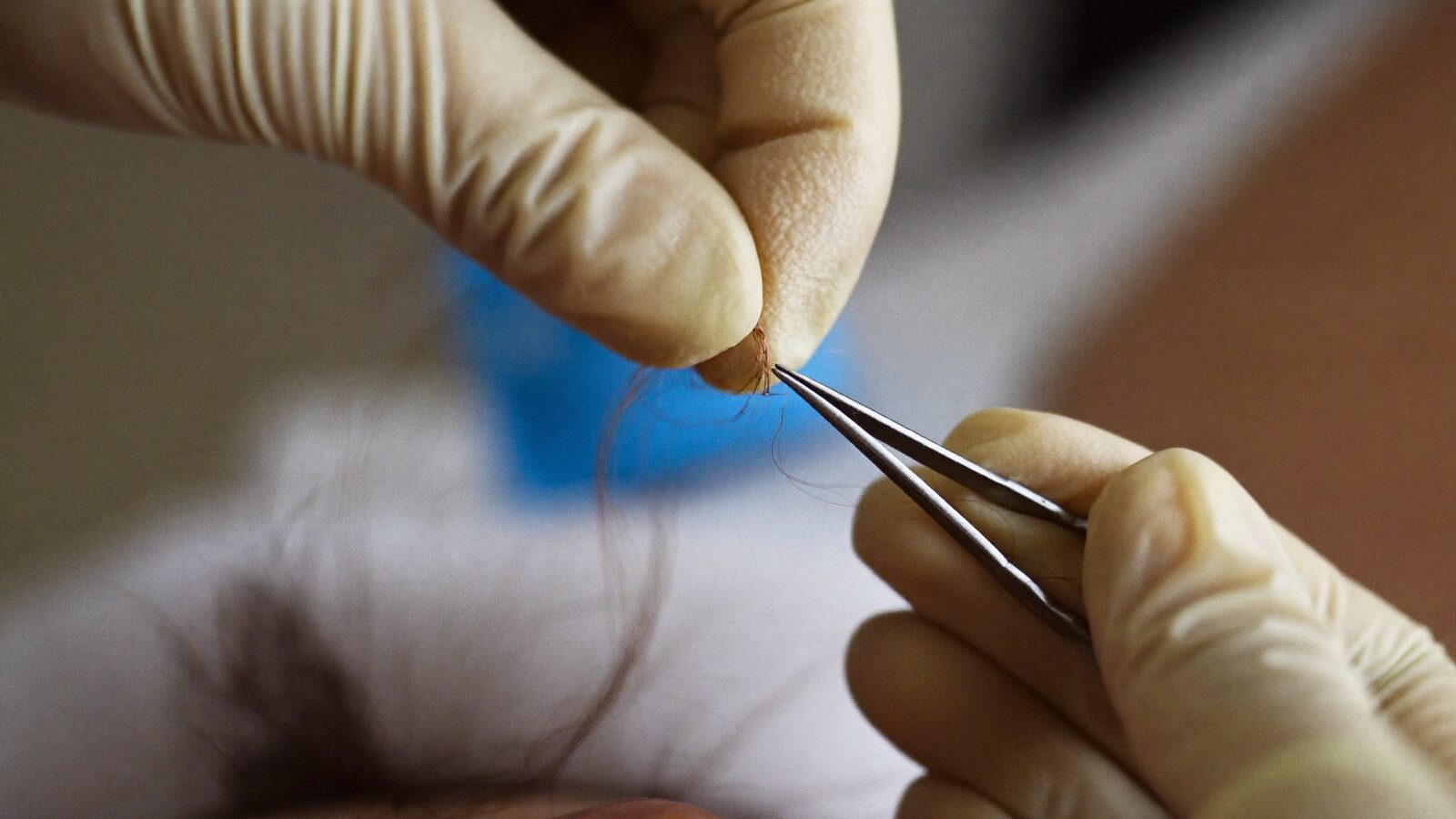
DHI vs FUE is not really a contest between two different surgeries. DHI (direct hair implantation) is a way of placing grafts during an FUE (follicular unit extraction) procedure: the grafts are harvested the same way, and the difference is only the tool that puts each one into the scalp. In DHI that tool is an implanter pen; in classic FUE it is a pair of fine forceps working into tiny openings made beforehand.
So the useful question is not which technique wins, but whether the pen helps your particular plan. At our West Loop clinic both placement styles are available, and the choice is made graft zone by graft zone, not as a package you buy. If you want the full overview of the procedure first, our FUE hair transplant in Chicago page covers extraction, healing and results in one place.
Key takeaways
- DHI is a placement method used inside an FUE procedure, so extraction, donor healing and graft survival basics are the same for both.
- An implanter pen opens the skin and seats the graft in one motion, while classic FUE placement uses pre-made recipient sites and fine forceps.
- The pen is most useful for tight packing between existing hairs and for unshaven or partially shaved sessions.
- For large open areas such as a bald crown, classic site-and-forceps placement usually achieves the same result in less time.
- Many plans combine both: pens along the hairline or among native hair, forceps for the broad zones behind it.
What does DHI actually change in an FUE procedure?
DHI changes only the implantation step of an FUE hair transplant. Instead of a technician first creating hundreds of small recipient openings and then sliding grafts into them with forceps, each graft is loaded into the hollow needle of an implanter pen, and the pen creates the opening and deposits the graft in a single push.
The name is often marketed as a separate operation, so many patients assume they must pick one. In practice, everything that decides whether a transplant looks natural still happens the same way: the donor assessment, the hairline design, the graft count and the angle each hair needs to grow at. The pen is a delivery tool, much like a choice of brush is a choice inside painting rather than an alternative to it.
Extraction is the same in both methods
Extraction is identical whether the grafts are later placed with a pen or with forceps. In both cases individual follicular units, the natural groups of one to four hairs, are removed one at a time from the back and sides of the scalp with a small circular punch, leaving tiny dot scars that the surrounding hair covers.
At Nova Medical Hair Transplant Chicago, extraction is done by hand with fine handheld FUE instruments by our full-time, in-house team of licensed technicians and assistants. There are no robots or suction devices in the process, and no travelling technicians. The donor area is protected from overharvesting, with reserve left for any future loss, so the graft count is set by your donor density rather than by the placement method.
This matters for the comparison because the riskiest part of any graft's journey, the moment it leaves the donor skin, does not change with DHI. Transection, meaning a follicle cut during extraction, depends on punch skill and hair angle. It has nothing to do with which tool places the graft later. Our article on manual vs robotic FUE explains why hand extraction remains the standard here.
Two ways to place a graft: forceps or an implanter pen
The two placement styles differ in sequence, staffing and handling. Classic FUE placement separates site creation from implantation, so the angle and density pattern are locked in first and grafts follow. DHI combines both actions, so angle and depth are set at the moment each graft goes in, one pen load at a time.
| Factor | Classic FUE placement | DHI implanter pen |
| Recipient openings | Made in advance as a full map | Made by the pen as each graft goes in |
| Graft handling | Picked up with forceps, slid into the site | Loaded into a needle, pushed out by a plunger |
| Speed over large bald areas | Usually faster | Usually slower, one load per graft |
| Working between existing hairs | Possible, needs careful site planning | Easier to avoid cutting native hairs |
| Unshaven or partly shaved sessions | Harder in long hair | Well suited |
| Team needed | Site maker plus placers | Pen loaders plus implanters |
| Extraction method | Manual FUE | Manual FUE |
Neither column is better on paper. A well-run forceps session and a well-run pen session can produce the same hairline, and both depend on a team that respects graft hydration and time out of the body.
Where does the implanter pen help most?
The implanter pen helps most where grafts must go in between hairs that are still growing, and where the patient prefers not to shave the top. Because the pen opens and fills each site in one motion, the team can thread grafts among native hair with less risk of cutting it and without a large field of empty openings.
These are the situations where we most often recommend pen placement:
- Densifying a thinning area: when the front still has a fair amount of native hair, the pen lets grafts slip between existing strands without a pre-made grid that could injure them.
- Unshaven or partially shaved work: for patients who need to return to work quickly, the pen works more comfortably through longer hair. Our guide to non-shave FUE explains who qualifies.
- Fine hairline refinement: placing single-hair grafts at a sharp, low angle along the front edge can be easier with a small-gauge needle.
- Small touch-up sessions: a few hundred grafts into scar tissue or a gap left by earlier work can be placed precisely without mapping a full field.
Dr. Otto Placik reviews and approves every plan, designs the hairline with the patient and oversees the procedure, including the decision on where pens make sense. You can read more about how pen placement fits our process on the DHI hair transplant page.
Where DHI adds cost or time without a clear benefit
DHI adds time without a clear payoff when the recipient area is large and mostly bald. On an open crown or a fully receded front, there are no native hairs to protect, so the main advantage of the pen disappears, while loading a pen for every graft still slows the session compared with site-first placement.
Time matters because grafts are living tissue. The longer a large session runs, the more important it is to keep grafts cool, moist and organized. A team placing 3,000 grafts into an empty crown with forceps into pre-made sites can usually work efficiently, and the result will look the same as if each graft had been pushed in by pen.
Cost is the other point patients ask about. Some clinics advertise DHI as a premium package with a higher price simply because of the name. At our clinic, pricing is per graft, from $3.99 to $7.99, with most procedures between $4,000 and $15,000, no session fees and 0% financing for the first 12 months. Your written quote comes after a free assessment, and the hair transplant cost in Chicago page explains what moves a quote up or down. Our explainer on per-graft pricing walks through sample quotes.
Worth knowing: if a clinic quotes DHI and FUE as two separate products with different prices, ask what actually changes in the operating room. If extraction is the same, the difference should come down to placement time and team setup, not a new procedure.
Real-world scenarios: which placement fits which plan
Most real plans are a blend, so it helps to see how the choice plays out for typical patients. The scenarios below are examples of common patterns, not promises, and each one would be confirmed in person after a donor exam and a look at how much native hair is left in the recipient zone.
- Early recession at the temples, hair kept medium length: a man in his late twenties with Norwood 2 to 3 recession (the Norwood scale grades male pattern loss from 1 to 7) who cannot be seen with a shaved head. Pens through partially shaved recipient strips are often a good fit, with roughly 1,200 to 1,800 grafts.
- Bald crown with a stable front: a patient in their forties whose front is holding but whose crown is open. Classic site-and-forceps placement is usually efficient here, since there is little native hair to work around. A later session can still refine the front once the crown has grown in.
- Diffuse thinning on top with plenty of native hair: pens are often preferred because the goal is density between existing strands, not new coverage on bare skin.
- Large plan near the one-day limit: for sessions approaching about 4,000 grafts, the team often uses forceps for the broad middle zone and pens for the hairline, keeping the day efficient. Very large plans are split into two sessions.
Does DHI heal faster or grow better than FUE?
DHI does not reliably heal faster or grow better than classic FUE placement when both are done carefully. Both follow the same arc: tiny scabs in the recipient area for about 7 to 10 days, shedding of the transplanted hair shafts around weeks 2 to 6, early growth from months 3 to 4 and a mature result around 12 months.
Some marketing claims that DHI causes less bleeding or tighter healing because no channels are opened in advance. In everyday practice, the factors that drive healing are graft handling, site size, the patient's own skin and how closely aftercare is followed. Both methods use small openings matched to the graft size, and both are done under local anesthesia with patients going home the same day. Swelling, redness and the sleep routine for the first nights are the same either way.
How do you choose between DHI and classic FUE?
You choose between DHI and classic FUE placement by matching the tool to the recipient area, not to a brochure. If you are adding density among existing hair or keeping your hair long, pens usually help. If you are covering a large bald zone, classic placement is often just as natural and quicker to finish.
These questions will get you a clear answer at any consultation:
- Which zones get pens and which get forceps? A thoughtful plan can name them, for example pens for the front 2 centimeters and forceps for the mid-scalp.
- Who extracts and who places? At our clinic it is the same in-house team every day, with Dr. Placik overseeing the procedure.
- Does the price change with the placement tool? Here, the quote is per graft within the published range.
- Do I need to shave? The answer depends on graft count and placement plan, and it should be settled before booking.
- How many grafts can my donor area safely give? This sets your ceiling regardless of method.
If you are still deciding, a free assessment at our clinic at 215 N Peoria St, Suite 100, in the West Loop is the simplest next step. You leave with a written graft estimate, a placement plan and a quote, so the DHI or FUE question has a concrete answer for your scalp.
Find Out Which Placement Suits Your Scalp
Book a free assessment in the West Loop. We check your donor area, map pen and forceps zones and give you a written per-graft quote.