
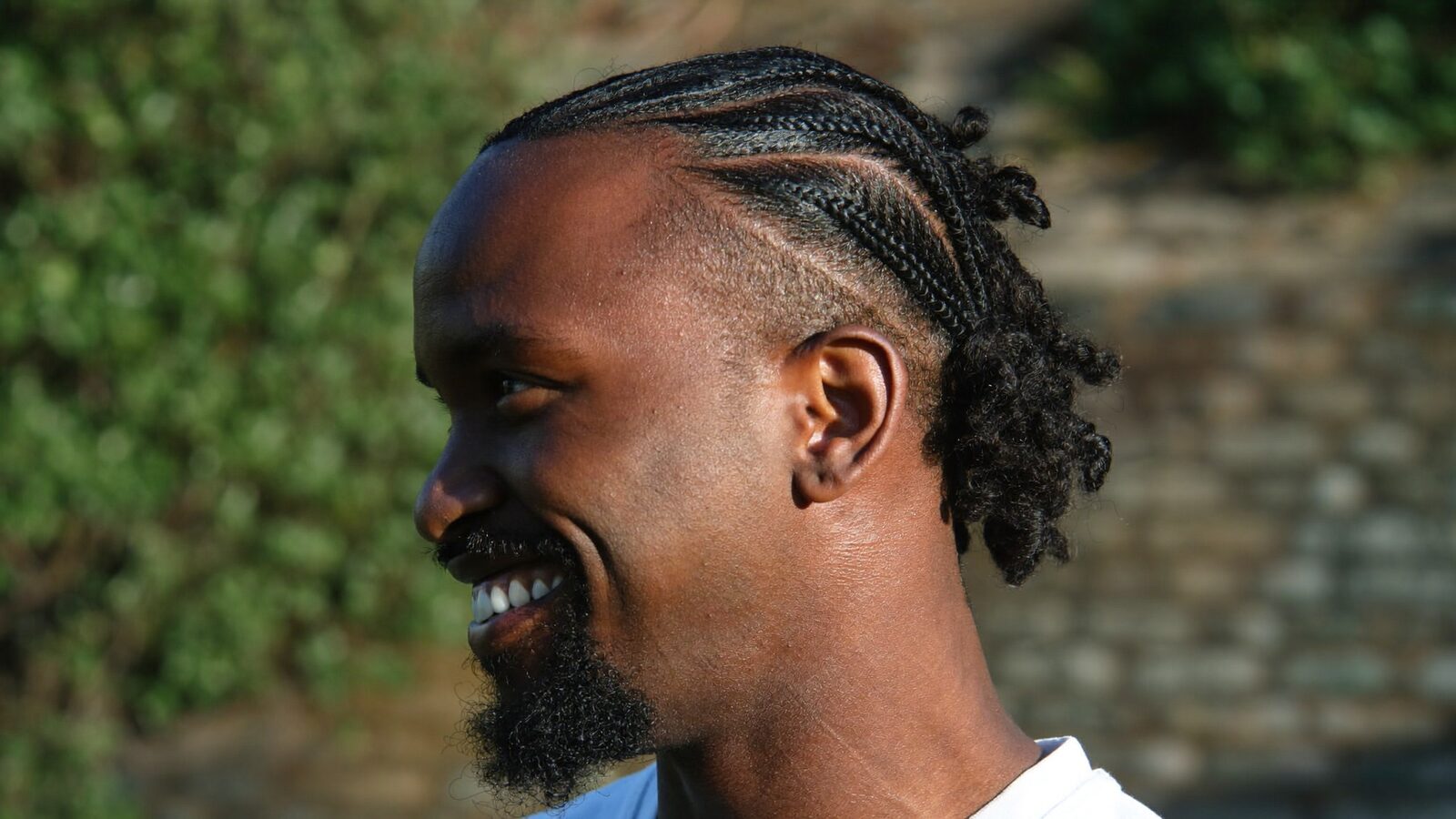
An afro hair transplant works on the same principle as any other: healthy follicles are moved from the back and sides of the scalp to thinning areas. The difference is beneath the skin, where tightly coiled hair grows from curved follicles. That curve changes how grafts are extracted and placed, and it is also why curly hair often gives more visual coverage per graft than straight hair.
This guide explains how curl under the skin affects the procedure, how extraction is adapted, how hairline design differs across hair types and backgrounds, and what coverage to expect by texture. For the procedure basics, our FUE hair transplant page describes the handheld technique used at the clinic.
Key takeaways
- Afro-textured and tightly curled hair grows from curved follicles, so extraction has to follow the curve to avoid cutting the follicle.
- Curly hair usually looks fuller per graft than straight hair, so the same number of grafts often gives more visible coverage.
- Both FUE and FUT can work for curly hair; the choice depends on donor density, curl tightness and how short you wear your hair.
- Hairline shape should follow the person's own features and original hair pattern, not a single template.
- A transplant does not change hair type: transplanted follicles keep the texture they had in the donor area.
How does curl under the skin change a hair transplant?
Curl under the skin changes a hair transplant because a coiled hair is shaped by a curved follicle that bends below the surface. A straight-haired follicle runs in a fairly straight line into the scalp, while a tightly curled follicle can arc noticeably. Any instrument that ignores that arc risks cutting the follicle and damaging the graft.
The surface gives clues about what lies beneath. Hair that coils tightly at the scalp usually comes from a follicle with a pronounced bend. Looser waves usually mean a gentler curve. During the assessment, the team looks at the hair close to the skin, often trimmed short, to judge how much the follicles curve and in which direction.
The curve matters in three ways:
- Extraction risk: transection, meaning a follicle cut across during removal, is more likely if the instrument does not follow the curve.
- Graft size: curved follicles often need a little more surrounding tissue to come out intact.
- Placement: recipient sites must be deep and shaped enough to hold a curved graft without bending or crushing it.
Extraction for curly and afro-textured follicles
Extraction for curly and afro-textured follicles is slower and more deliberate than for straight hair. With FUE (follicular unit extraction), each graft is scored at the surface and then freed along the line of the follicle, adjusting depth and angle as the curve shows itself. With FUT (follicular unit transplantation), a strip is removed and grafts are separated under magnification, where the curve can be seen directly.
At the clinic, FUE grafts are extracted by hand with fine handheld instruments by a full-time team of licensed technicians, which allows each graft to be guided individually rather than pulled by suction or a robot. FUT is also offered, and for some patients with very tightly coiled hair it is a sensible choice because the follicles are dissected under direct view. Our comparison of FUE vs FUT walks through the trade-offs.
| Consideration | FUE for curly hair | FUT for curly hair |
| How follicles are removed | One by one, following each curve by feel and sight | As a strip, then dissected under magnification |
| Donor scar | Small scattered dots, easy to hide with very short hair | One fine line, hidden under longer hair |
| Short haircuts | Generally suits very short styles | Better for patients who keep some length at the back |
| Main challenge | Avoiding transection on tightly curved follicles | Healing of the strip line in scar-prone skin |
Scar check: People with darker skin can be more prone to keloids, raised scars that grow beyond the original wound. If you or close family members form keloids, tell the team at the assessment, because it affects which technique is recommended and whether a small test area is sensible first.
Hairline design across ethnicities
Hairline design across ethnicities starts with the individual, not a group label. Many patients with afro-textured hair have a naturally straighter, more rounded front hairline with softer temple corners, while many patients of European descent have a more arched line with deeper corners. Patients of East Asian descent often have flatter, slightly lower hairlines. These are tendencies, and a family photo usually tells more.
A practical rule is to rebuild the hairline the person originally had, adjusted for age. Old photos from the late teens or early twenties often show the natural shape, height and corners. Dr. Otto Placik designs the hairline with the patient using those references and the proportions of the face, then reviews the angle and direction the grafts will follow.
Direction is especially important with tightly curled hair. Afro-textured hair at the hairline often grows at a low angle and curls back toward the scalp, so grafts placed too upright can look tufted. Hairline edges are also built from single-hair grafts, even in very dense hair, to keep the front soft. For more on balancing face shape and hairline height, see our guide to hairline design and face shape.
- Shape: rounded or straight lines suit many afro-textured hairlines; arched lines with deeper corners suit many straight-haired patients.
- Edges: a slightly irregular edge looks natural on every hair type; a crisp, straight edge looks drawn.
- Temples: softer, rounder temple corners are common with afro-textured hair and are often planned that way.
- Grooming: if you wear a sharp line-up, the design leaves room for the barber to shape the edge without exposing the grafts.
How much coverage can you expect by hair texture?
Coverage by hair texture differs because curls take up more space than straight strands. A tightly coiled hair lifts off the scalp and overlaps its neighbors, so it hides more skin than a straight hair of the same thickness. As a result, afro-textured hair often looks fuller with fewer grafts, while fine, straight hair usually needs more grafts for the same visual density.
Other features matter as much as curl. Thick hair shafts cover more than fine ones. Low contrast between hair color and skin color makes thinning less visible, while dark hair on pale skin shows every gap. The table below summarizes typical tendencies; your own assessment refines them.
| Hair type | Visual coverage per graft | Planning notes |
| Tightly coiled, afro-textured | High | Careful extraction; often lower graft density looks full |
| Loose curls and waves | Moderate to high | Good coverage; waves help hide the scalp |
| Straight, thick shafts | Moderate | Strong individual hairs; angle and direction are critical |
| Straight, fine shafts | Lower | Often needs more grafts for the same look |
Donor density sets the ceiling for everyone. Donor density in afro-textured hair can be somewhat lower in hairs per square centimeter, but the coverage advantage of curl usually balances that. Up to about 4,000 grafts can be placed in one day depending on donor density, and the clinic always leaves reserve in the donor area for future loss.
Can a transplant change your hair type?
No, a hair transplant cannot change your hair type. Transplanted follicles keep the curl, thickness and color they had in the donor area, so curly donor hair grows curly at the hairline and straight donor hair grows straight. Some patients notice slight differences in the first year while new hair matures, but the texture settles to match the donor.
This is reassuring for most patients, because it means the new hair blends with the rest of the head. It also means a transplant cannot turn tightly coiled hair into loose waves, or straight hair into curls. If you want a different texture, that is a styling question rather than a surgical one.
Where the new hair goes is a separate decision from texture. Patients with curly hair face the same choice as everyone else about whether to treat the front or the back first, which our guide to treating the crown or the hairline first explains in detail.
Early regrowth can look a little wiry or frizzy, especially around months 4 to 8. That usually reflects young hairs that have not reached full thickness yet, and most patients find the texture evens out by about a year.
Traction alopecia and other causes common with curly hair
Traction alopecia is hair loss caused by repeated pulling from tight braids, weaves, extensions, locs or ponytails, and it is common in people with textured hair. It usually affects the hairline and temples. A transplant can restore those areas once the pulling has stopped and the loss has stabilized, because grafts placed under the same tension can be lost again.
Before recommending surgery, the team checks whether loss is from traction, from pattern balding (androgenetic alopecia) or from a scarring condition that needs medical treatment first. That distinction affects both candidacy and the plan. Questions worth bringing to your assessment:
- Cause: is my loss from traction, genetics or a scalp condition?
- Technique: does my curl pattern favor FUE or FUT?
- Scarring: does my skin or family history suggest a keloid risk?
- Styling: when can I return to braids, a line-up or other protective styles?
- Proof: can I see results on hair textures similar to mine?
Results across a range of hair types appear in our before and after gallery, and the full planning process is described on our Chicago hair transplant clinic page.
Get a Plan Built for Your Hair Type
Book a free assessment at our West Loop clinic. We will look at your curl pattern and donor area and give you a written plan, technique advice and price.