
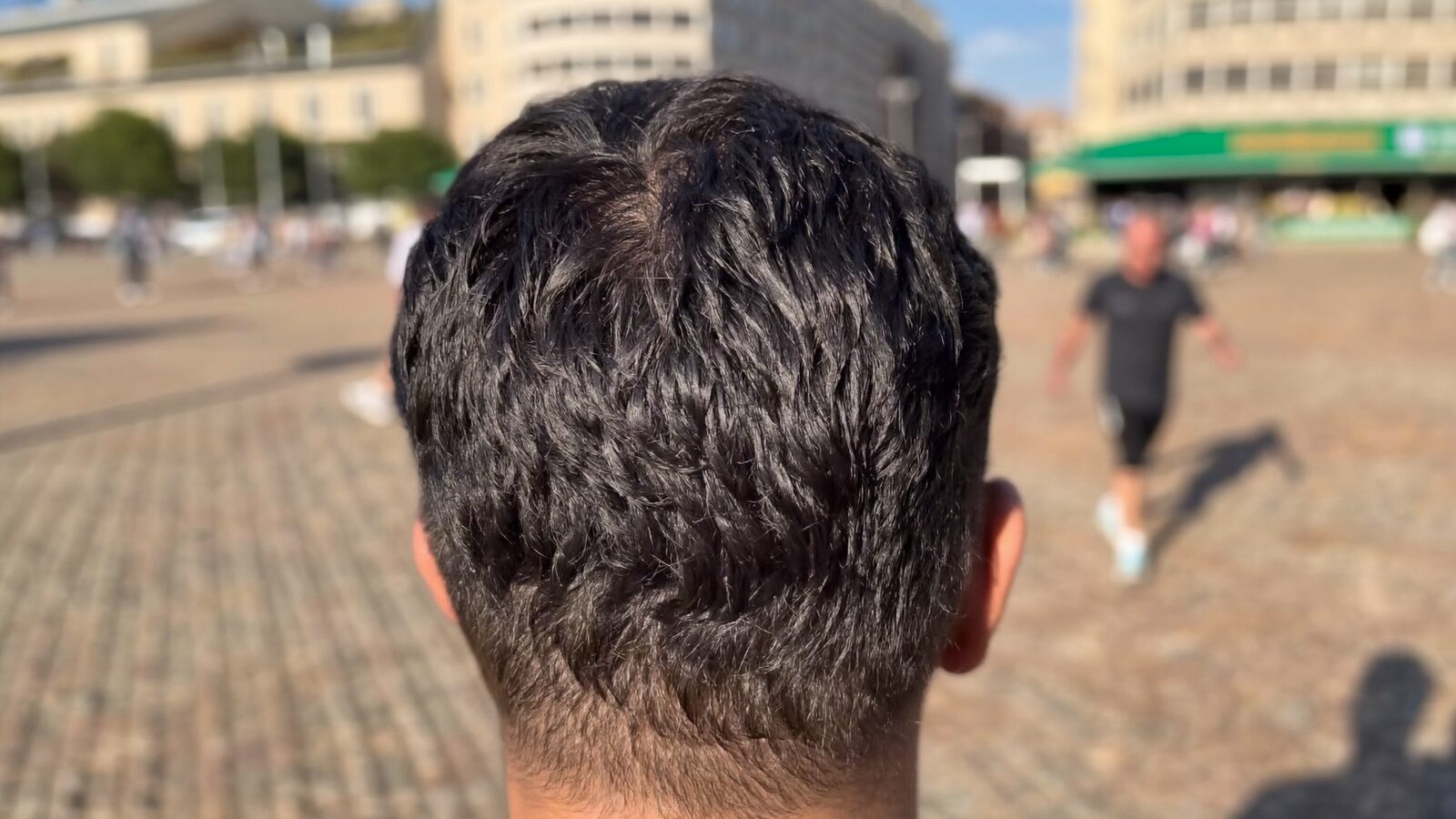
A crown hair transplant can restore a bald spot on the back of the top of the head, but it is planned differently from hairline work. The crown (also called the vertex) is the round area where hair grows in a swirl, it usually needs more grafts to look full, and it is often treated after the front when donor hair is limited.
If you have noticed a thinning circle in photos taken from above, this guide explains how a transplant is planned zone by zone, why the crown is the most graft-hungry part of the scalp and how to decide what to treat first. For the extraction method used at our West Loop clinic, see our FUE hair transplant in Chicago page.
Key takeaways
- A crown bald spot caused by pattern hair loss can usually be treated with a transplant when the donor area on the back and sides of the scalp is healthy.
- The crown typically needs more grafts than the hairline for the same visual result, often 1,000 to 1,500 for a small spot and 2,000 or more for a larger one.
- Crown grafts are placed in a whorl that radiates from a center point, which takes careful angle and direction planning.
- When grafts are limited, most plans put the hairline first because the front frames the face and the crown can keep expanding with age.
- Crown growth tends to mature more slowly than the front, often taking 12 to 18 months to reach its final density.
Three zones, three different jobs
A hair transplant treats the scalp as separate zones, each with its own job. The hairline frames the face, the mid-scalp provides the bulk of visible volume from the front, and the crown covers the top-back area seen from above. Each zone uses different graft sizes, angles and densities, so a good plan is really three plans that blend together.
The hairline uses fine, single-hair grafts at the very edge, arranged in a slightly irregular line so it never looks like a ruler was used. Just behind it, two and three-hair grafts build volume. The temples, at the sides of the hairline, need hairs placed very flat to the skin because the growth there points down and back.
The mid-scalp, between the hairline and the crown, is where hair falls forward or to the side and creates the impression of thickness from the front. The crown sits behind it, at the highest point of the back of the head, where hairs fan out in a circle. Underneath all of them is the donor zone on the back and sides, which supplies every graft.
| Zone | Main job | Typical grafts used | Placement challenge |
| Hairline and temples | Frame the face | Mostly single-hair grafts at the edge | Soft, irregular edge and very low angles |
| Mid-scalp | Volume from the front | Two and three-hair grafts | Matching forward and sideways flow |
| Crown (vertex) | Coverage from above | Mix of multi-hair grafts | Recreating the swirl in every direction |
| Donor area | Supplies all grafts | Not a recipient zone | Removing grafts without visible thinning |
Can a hair transplant fix a bald spot on the crown?
Yes, a hair transplant can fix a bald spot on the crown in most people whose loss comes from androgenetic alopecia (genetic pattern hair loss) and whose donor area is healthy. Follicles taken from the back and sides resist DHT, the hormone that shrinks crown follicles, so they usually keep growing in their new position for many years.
The crown is one of the first places pattern loss shows in many men. On the Norwood scale, which grades male hair loss from 1 (no recession) to 7 (only a horseshoe of hair left), crown thinning appears as a separate pattern at stage 3 vertex and then gradually joins the receding front. Women with pattern loss usually thin more diffusely across the top rather than in a round spot.
Not every bald spot is pattern loss. Alopecia areata, an autoimmune condition, causes round smooth patches that can come and go, and is generally not treated with a transplant. Scarring conditions, thyroid problems and nutritional issues can also play a part. That is why the assessment starts with a diagnosis before any graft count is discussed.
Both FUE (follicular unit extraction, where follicles are taken one by one) and FUT (follicular unit transplantation, where a thin strip is removed and divided) can supply grafts for the crown. Our comparison of FUE vs FUT covers how to choose between them.
Why does the crown need more grafts?
The crown needs more grafts because of its shape and the way it is viewed. Hairs in a swirl point in every direction, so they overlap less than hairs lying in one direction at the front. The crown is also seen from above, under overhead light, which makes lower density easier to spot. Covering the same area convincingly therefore takes more grafts.
At the hairline, hairs lie forward and stack like shingles, so a moderate density looks full when viewed from the front. In the crown, hairs fan out from a center point, and gaps between them show the scalp more readily. Many surgeons also note that crown bald spots tend to grow larger over time, so the treated area keeps expanding.
As a rough guide, a small crown spot often needs about 1,000 to 1,500 grafts, while a larger one can take 2,000 to 3,000 or more. The exact number depends on the size of the area, the thickness and curl of your hair and the contrast between hair and skin color. Thick, wavy or curly hair covers more scalp per graft, a point our guide to transplants for curly and Afro-textured hair explores.
Watch for: some clinics split grafts into smaller pieces to inflate the count. A higher number of split grafts does not give more hair, and it can lower survival. Ask how many hairs, not only how many grafts, a plan will move.
The swirl: placing grafts in a whorl
The swirl, or whorl, is the spiral pattern at the center of the crown where hair radiates outward. A natural crown transplant follows that pattern exactly: each graft is angled to point away from the center, curving clockwise or counterclockwise to match the existing hair. Getting the direction wrong makes the crown look spiky or unnatural, even with plenty of grafts.
The first step is finding the original center of your whorl, which is often still visible in the remaining hair at the edges. Some people have two whorls, and their placement has to respect both. The team then maps the direction in rings around the center, so hairs closer to the middle stand slightly higher and those further out lie flatter.
Recipient sites, the small openings that receive the grafts, are made at those planned angles. At Nova Medical Chicago, grafts are extracted by hand with fine handheld FUE instruments by a full-time, in-house team of licensed technicians, and placement can also be done with an implanter pen when it suits the case. Dr. Otto Placik reviews and approves every plan and oversees the procedure.
Hairline first or crown first?
When donor hair is limited, most plans treat the hairline first and the crown second. The hairline frames the face and is what people see in conversation, while the crown is mostly seen from above or behind. Treating the front first also protects you if loss continues, because a restored front with a thin crown still looks natural.
The reverse can create problems. If grafts are spent on the crown and the front keeps receding, the result can look like an island of hair at the back with a bare forehead, which needs even more grafts to fix. The crown also has a habit of widening, so a crown treated too early in a young patient may later need a second session.
There are exceptions. Patients whose hairline is stable and who mainly dislike the bald spot may treat the crown alone. When the donor supply is strong, both zones can be done in a single day of up to about 4,000 grafts, and very large plans are split into two sessions.
- Front first: receding hairline plus crown thinning, limited donor supply or ongoing loss.
- Crown only: stable hairline, a well-defined bald spot and realistic coverage goals.
- Both in one day: strong donor density and a combined need that fits within one session.
- Two sessions: extensive loss where front and crown together exceed what one day can safely provide.
What does full coverage really mean?
Full coverage means the scalp no longer shows through obviously under normal conditions, not that the crown matches the density you had at 18. A transplanted crown is designed to look natural in daylight and in photos taken from above, with density that is good enough rather than maximal, because donor hair must also be saved for the front and for the future.
Most crown results are judged by the illusion of fullness. Hair length, styling and color contrast all affect how well the scalp is covered. Light hair on light skin hides thinner areas better than dark hair on pale skin, and slightly longer hair at the crown gives more coverage than a very short cut.
Patience matters more at the crown than anywhere else. Crown growth is often slower than at the front, and many patients see the final result between 12 and 18 months after surgery. Medication to protect the native hair around the crown is often discussed, because a transplanted spot surrounded by thinning hair loses its effect.
Planning your crown consultation
A crown consultation measures four things: the size of the bald or thin area, the density and quality of your donor zone, how active your hair loss is and what you want the result to look like from above. Those four answers decide the graft count, the order of treatment and whether one or two sessions make sense.
Bring photos of your crown taken over the past few years if you have them, because they show how fast the area is changing. Expect to discuss your likely pattern in ten years, not only today. Pricing is per graft, with no session fees and 0% financing for the first 12 months, and our hair transplant cost in Chicago page explains how quotes are built.
It also helps to see real crown work before deciding. Browse the before and after gallery for cases with a similar starting point, and keep a short list of questions for the assessment, such as how many grafts are reserved for the future and how the whorl will be recreated. Our hair transplant FAQ covers many of the other questions patients bring.
Map Your Crown and Hairline
Book a free assessment in the West Loop. We will measure your donor area, size your crown and give you a written plan that sets the right order for treatment.