
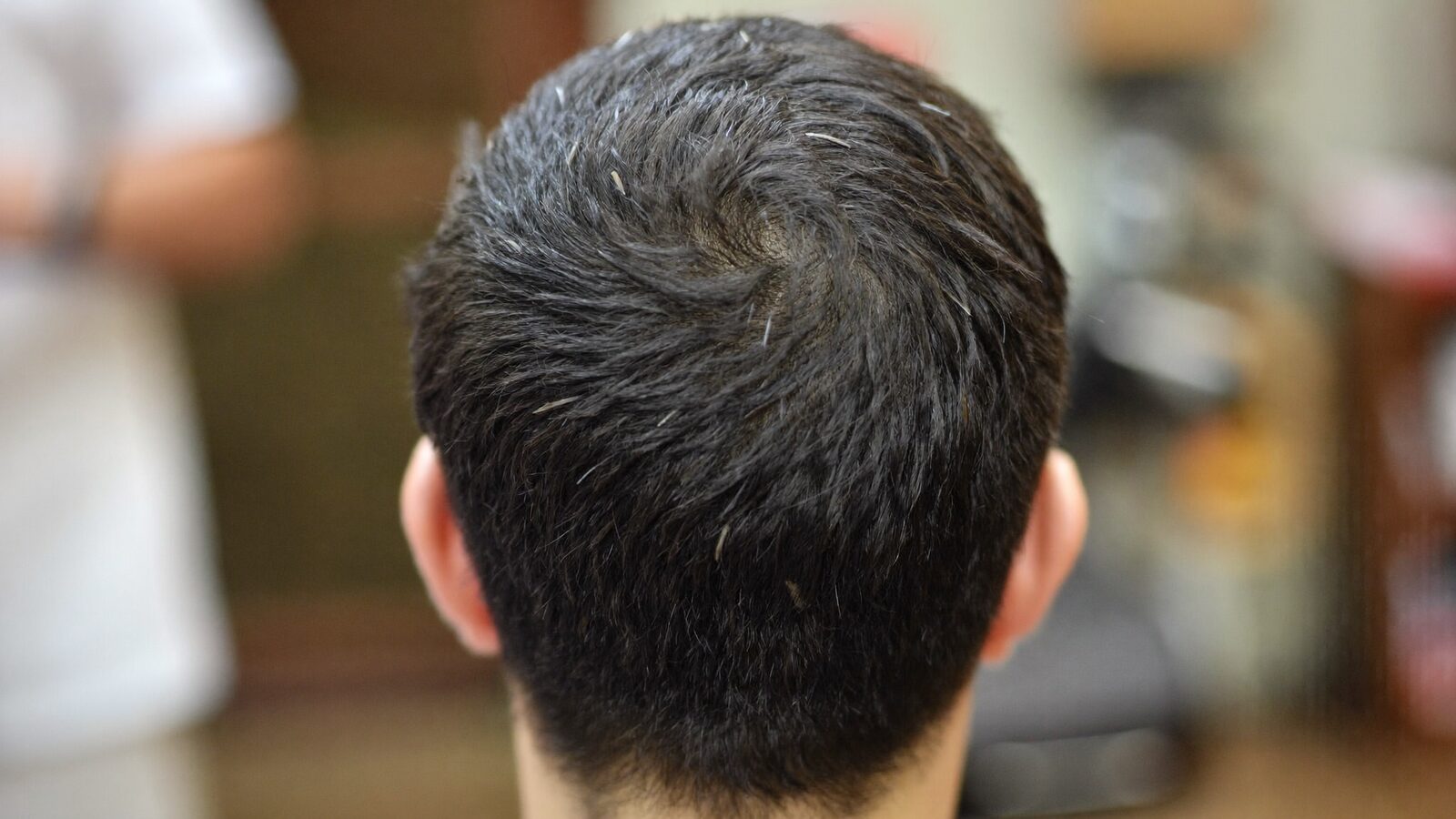
Every donor area hair transplant plan starts with one fact: the band of permanent hair on the back and sides of your scalp holds a fixed number of follicles. That fixed number is your lifetime graft budget: every graft moved to the hairline or crown is one fewer left behind, so no honest clinic can promise unlimited grafts. A good plan spends that budget carefully and keeps some in reserve.
At our West Loop clinic, the donor zone is the first thing we examine, before anyone talks about hairlines or graft counts. This guide explains how donor density is measured, what overharvesting looks like, and why a plan that ignores future loss can unravel years later. If you are weighing extraction methods, our FUE hair transplant page explains how individual grafts are taken from the donor zone by hand.
Key takeaways
- The donor area is the back and sides of the scalp, where follicles are genetically resistant to the hormone DHT and keep growing after they are moved.
- Donor density is counted in follicular units per square centimeter, and most adults fall somewhere between about 60 and 90 units per square centimeter.
- Only a share of donor follicles can be removed before the area itself starts to look thin, so every patient has a finite lifetime graft supply.
- Offers of unlimited grafts usually mean overharvesting, which can leave a see-through donor zone that is hard to repair.
- A sound plan leaves grafts in reserve for hair you have not lost yet, because pattern loss often continues for decades.
What is the donor area in a hair transplant?
The donor area in a hair transplant is the horseshoe-shaped zone at the back and sides of the head where hair rarely thins, even in men with advanced balding. Follicles there are largely resistant to dihydrotestosterone (DHT), the hormone behind pattern loss, and they keep that resistance after being moved to a thinning area.
This idea, often called donor dominance, is the whole reason transplants work. A follicle carries its genetic behavior with it, so a graft taken from the safe zone above the neck should keep producing hair in the hairline for life.
The safe zone has edges, though. Hair near the top of the horseshoe and low on the neck can be less stable in some people. Grafts taken from those borders may thin later, which is one reason extraction stays inside a mapped region rather than wherever hair happens to look thick today.
Your lifetime graft budget
Your lifetime graft budget is the total number of follicular units that can be removed from the donor area without the donor area itself looking thin. For many men with average density, that budget lands somewhere around 5,000 to 7,000 grafts across all procedures combined, though it can be noticeably higher or lower from person to person.
A follicular unit is a natural cluster of one to four hairs that grows from the same opening in the skin. Grafts are these units, so the budget is counted in grafts, not individual hairs. Most donor zones average a little over two hairs per graft.
The budget is shared by every procedure you will ever have. If a first session uses 3,500 grafts, those grafts are gone from the donor supply for good. That is why we look at your whole future, not just the area that bothers you most this year.
| Donor profile | Typical density | What it usually means for planning |
| Strong donor | About 80 or more units per square centimeter, many 3-hair units | Room for a full frontal plan and a later crown session in many cases |
| Average donor | About 65 to 80 units per square centimeter | Hairline and front third first, crown only if supply allows |
| Limited donor | Below about 60 units per square centimeter, fine hair | Smaller, targeted plan focused on framing the face |
| Unstable donor | Thinning or miniaturized hair in the donor zone itself | Surgery is often postponed or not advised |
How is donor density measured?
Donor density is measured by counting follicular units inside a small marked area of the donor zone, usually one square centimeter, under magnification. The count, the number of hairs per unit and the thickness of each hair are then combined to estimate how many grafts the donor area can safely give over a lifetime.
At a consultation, the hair in a few spots is trimmed short so the openings are easy to see. A handheld magnifier or a digital scope, a process called trichoscopy, shows how many units sit in the window and whether any hairs are miniaturized, meaning thinner and shorter than their neighbors. Miniaturization in the donor zone is a warning sign that the area may not be as permanent as it looks.
Several other factors change how far a donor supply goes:
- Hair caliber: Thick shafts cover more scalp per graft, so a coarse-haired patient often gets more visual coverage from the same count.
- Hairs per unit: A donor zone rich in 2-hair and 3-hair units delivers more hair per graft than one made mostly of singles.
- Color contrast: Dark hair on pale skin shows thinning more than hair that is close to the skin tone, which affects how much density is needed.
- Curl and wave: Curly or wavy hair lifts off the scalp and tends to look fuller than straight hair at the same density.
- Scalp laxity: A looser scalp matters most when strip harvesting (FUT) is being considered, since it affects how wide a strip can be taken.
Why can no clinic promise unlimited grafts?
No clinic can promise unlimited grafts because the donor area contains a fixed number of follicles and none of them grow back once extracted. A clinic can only take a safe share of that supply. Advertising unlimited grafts either means the number will be capped quietly on the day, or that the donor zone will be overharvested.
The phrase usually appears in package pricing, where one flat fee covers as many grafts as the clinic decides to place. That can sound generous. In practice it rewards moving as many grafts as possible in one sitting, which is the opposite of protecting your future options.
Our approach is the reverse. Pricing is per graft, the count is written into your quote before surgery, and Dr. Otto Placik reviews every plan to confirm the number makes sense for your donor zone. In a single day the team can place up to about 4,000 grafts when donor density allows. Very large plans are split into two sessions so the donor area can recover between them.
A useful test: Ask any clinic how many grafts your donor area can give over your lifetime and how much of that your plan uses. A clear number for both is a good sign. A promise with no number attached is not.
What overharvesting looks like
Overharvesting looks like a donor area that has become visibly sparse, patchy or moth-eaten, with scalp showing through the back and sides even when the hair is a few inches long. It happens when too many follicles are taken from one zone, or extraction sites are packed too close together, so the remaining hair can no longer hide the gaps.
With FUE (follicular unit extraction), each graft leaves a tiny round scar, roughly the size of a pinpoint. Spread evenly, hundreds of these scars disappear under short hair. Clustered, they merge into pale patches. Overharvesting can also shift the edges of the donor zone, taking grafts from unstable hair that later thins anyway.
Common signs patients describe include:
- See-through back: The scalp shows under bathroom lights or in photos from behind.
- Uneven patches: Some areas look normal while others look thin, a sign that extraction was not spread out.
- Buzz-cut limits: Short clipper lengths that used to look fine now show white dots.
- No reserve left: A later consultation finds too little donor hair for any further work.
Some overharvested donor zones can be softened, for example by camouflaging scars or by careful extraction from untouched parts of the zone. Each case is different, and our hair transplant repair service explains what is and is not realistic after a previous procedure.
Planning for future loss
Planning for future loss means designing today's procedure on the assumption that pattern hair loss will keep going, then leaving enough donor grafts in reserve to cover the next stage. A hairline that suits a 28-year-old with a Norwood 3 pattern has to still look natural if that patient later reaches a Norwood 5 or 6.
The Norwood scale grades male pattern loss from 1, a full juvenile hairline, to 7, where only the horseshoe remains. Younger patients are the hardest to plan for, because nobody can say exactly where their loss will stop. A conservative hairline, placed slightly higher and softer than they might want, protects them if the crown and midscalp thin later.
Medication is part of this planning too. Finasteride and minoxidil can slow the loss of native hair in the treated area, which reduces how many future grafts are needed. Our Nova Medical FUE protocol describes how donor protection and reserve are built into every plan, and our guide to a second hair transplant covers when a follow-up session tends to make sense.
Why do some hair transplant plans fail years later?
Some hair transplant plans fail years later because the transplanted hair stays while the native hair around it keeps thinning. A dense, low hairline can end up as an island in front of a bald midscalp, and if the donor area was spent early there may be nothing left to bridge the gap. The failure is in the plan, not the grafts.
This pattern is common among patients who come to us for a second opinion. The first procedure often looked good for three to five years. Then the crown opened up, the donor zone was already thin, and the person had to choose between a hairline that no longer matched the rest of the scalp or limited repair work.
Other long-term causes include grafts taken from outside the stable donor zone, which slowly miniaturize, and hairlines drawn too straight or too low for an older face. Our article on why some hair transplants look obvious walks through these design mistakes in more detail.
Questions to ask about your donor area
The most useful questions about your donor area ask for numbers: your measured density, your estimated lifetime graft supply, and how much of that supply this plan will use. Clear answers tell you whether a clinic is planning for your whole future or only for the procedure in front of you.
Bring these questions to any consultation, including ours:
- Density: What is my donor density, and is there any miniaturization in the donor zone?
- Lifetime supply: Roughly how many grafts can my donor area give over my lifetime?
- This plan: How many grafts will this session use, and what will be left in reserve?
- Distribution: How will extraction be spread so the donor area does not look thin afterward?
- Next stage: If my crown thins in ten years, will there be enough grafts left to treat it?
Myths about grafts and scarring are common, and our post on FUE myths and facts clears up several that affect how people judge donor-area claims.
Find Out What Your Donor Area Can Give
Book a free assessment at our West Loop clinic. We will measure your donor density, estimate your lifetime graft supply and give you a written plan and quote.