
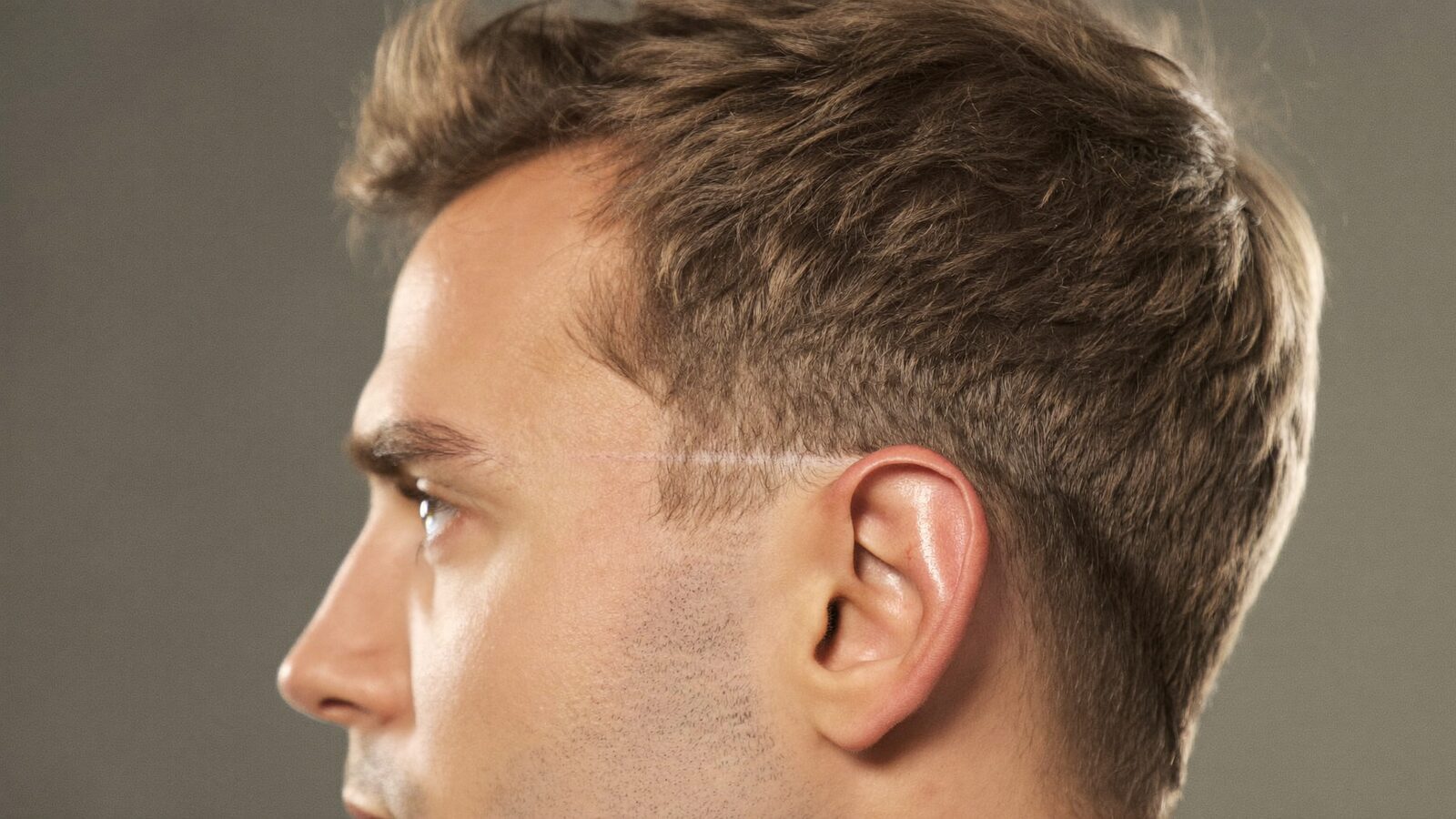
Temple point restoration is a small, detailed hair transplant that rebuilds the triangles of hair that point forward from the sideburns toward the eyes. Those points close the gap between the hairline and the sides of the head, so restoring them makes a face look framed again rather than just adding hair. Most cases need a few hundred single-hair grafts per side, placed at very flat angles.
Because the area is small but highly visible, the planning matters more than the graft count. This guide explains what temple points are, why they change the look of the whole face, how the grafts are angled and how many are typically needed. The extraction itself uses the same handheld technique described on our FUE hair transplant page.
Key takeaways
- Temple points are the small, forward-pointing triangles of hair above the sideburns, separate from the temple recession at the front hairline.
- Lost temple points can make a face look longer and older, even when the front hairline is still in reasonable shape.
- Temple hair grows almost flat against the skin, so grafts are placed at very acute angles, mostly as single-hair follicular units.
- Many temple point restorations use roughly 200 to 500 grafts per side, depending on the gap and the existing hair.
- Women can also benefit, usually for traction loss or a softly rounded temple that has thinned.
What are temple points?
Temple points are the pointed patches of hair that sit above each sideburn and project forward toward the outer corner of the eye. They are distinct from the temple recession, which is the corner of the front hairline. Together, the front hairline, the temple recession and the temple points form one continuous frame around the forehead.
A useful way to picture it: run a finger from the corner of your forehead straight back toward your ear. The hairline corner you pass first is the temple recession. The small triangle of hair below it, pointing toward your eye, is the temple point. In many men with mature pattern loss, the recession deepens first and the temple points thin or retreat later, which is why the two are planned separately.
Temple points can be lost for several reasons:
- Pattern hair loss: androgenetic alopecia, the inherited, hormone-driven form of balding, can erode the points over years, often alongside a receding hairline.
- Traction: tight braids, ponytails and extensions pull hardest at the temples and edges, which can leave lasting thinning there.
- Age: many people notice the points softening or shrinking gradually from their 40s onward.
- Earlier surgery: facelifts and brow lifts can move or reduce temple hair in some cases.
Why do temple points matter for the face?
Temple points matter because they shorten and soften the visible width of the forehead from the side. When they are missing, the eye travels from the hairline straight back to the ear across bare skin, which makes the face look longer and the hairline look higher than it is. Restoring them gives the face a closed, complete frame.
The effect is most obvious in profile and three-quarter views, the angles people see in photos and conversation. A man with a well-designed front hairline but empty temple points can still look as though something is missing. The reverse is also true: a modest front hairline paired with restored temple points often reads as fuller and younger than the graft count suggests.
Temple points also carry gender cues. In men they are usually more angular and point clearly forward. In women they tend to be rounder and blend smoothly into the side hair. Getting this shape right is part of why hairline design and face shape are planned together rather than one feature at a time.
Planning note: Temple points are never designed in isolation. Dr. Otto Placik reviews the front hairline, the recession and the points as one frame, so the restored points sit at a height and angle that will still suit the face as it ages.
Graft angles and density in the temple area
Graft angles in temple point restoration are much flatter than anywhere else on the scalp. Temple hair lies close to the skin and points down and back toward the ear, so each graft must be placed at a very acute angle and in the right direction. Single-hair grafts are used almost exclusively, because thicker units look tufted in this thin, exposed area.
Several details separate a natural temple from an obvious one:
- Direction: the hair at the tip of the point usually runs more horizontally, while hair near the sideburn turns downward. Grafts follow that gradual change rather than one fixed direction.
- Angle: sites are made almost parallel to the skin so the new hair lies flat instead of standing up.
- Graft size: one-hair follicular units, the natural groupings of one to four hairs that grow together, are chosen for the edges; occasionally a few two-hair units sit deeper inside the point.
- Density: temple points rarely need high density to look complete. Moderate, even spacing that matches the surrounding hair usually blends better than packing.
- Edge pattern: the outline is broken up slightly, because a crisp straight edge looks drawn on.
This is detailed, slow work for the extraction and placement team. The licensed technicians at the clinic select fine single-hair grafts during extraction so the temple can be built from the right material, and the placement follows the design that was marked and approved before the procedure.
How many grafts does temple point restoration take?
Temple point restoration usually takes roughly 200 to 500 grafts per side, so a pair of points often falls between 400 and 1,000 grafts in total. The exact number depends on how much of each point is missing, how much native hair remains, the caliber of the hair, and whether the front hairline is being treated in the same session.
| Scenario | Typical grafts per side | Common pairing |
| Points softened or thinned, outline still visible | About 150 to 250 | Often done alone |
| Points partly retreated, clear gap above sideburn | About 250 to 400 | Often paired with temple recession work |
| Points largely missing | About 350 to 500 | Usually part of a full hairline plan |
| Traction loss at temples and edges (often women) | Varies widely with the area | Often combined with edge restoration |
Because the area is small, temple work is frequently added to a larger hairline session rather than booked on its own. The cost is calculated per graft within the clinic's published range, and the free assessment gives you a written number before any decision. With up to about 4,000 grafts possible in one day depending on donor density, there is usually room to include the temples in a hairline plan without a second visit.
Temple work for women
Temple work for women most often treats traction alopecia, the thinning caused by years of tension from tight styles, or a softly receded temple that makes the forehead look wider. Female temple design is rounder and lower than a male point, with fine single hairs that blend into the side hair without a sharp tip.
Before any surgery, the cause of the thinning needs to be clear. Traction loss must have stopped, meaning the tight styling has changed, or newly placed grafts can be lost the same way. Diffuse female thinning across the whole scalp is assessed differently, and our female hair transplant page explains how candidacy is judged. Our post on feminine hairline transplants covers how women's hairline procedures differ more broadly.
Recovery and growth after temple restoration
Recovery after temple point restoration is usually quick, because the treated area is small. Swelling, when it happens, tends to collect around the eyes for a few days. Tiny crusts form and wash away within roughly 10 days, and many patients can cover the area with their existing side hair within a week.
The new temple hairs typically shed in the first weeks, then begin to regrow around months 3 to 4. Temple hair is fine and slow to look finished, so the full effect often takes 10 to 12 months or a little longer. Grafts are taken from the permanent donor zone at the back and sides of the scalp, so the restored points should keep growing long term; our post on how long hair transplants last explains why.
Is temple point restoration right for you?
Temple point restoration is a good fit when the missing points are what make your face look unframed, your donor area is healthy, and the cause of the loss has stabilized. It is less suitable when hair loss is still advancing quickly elsewhere and the donor supply is better reserved for the front and top of the scalp.
Questions worth asking at a consultation include:
- Priority: would grafts give more visible benefit at the temples or at the front hairline in my case?
- Shape: how angular or rounded should my temple points be for my face and age?
- Future loss: if my hairline keeps receding, will the restored points still look natural?
- Proof: can I see temple cases with similar hair color and texture to mine?
Seeing real results is the most reliable way to judge a clinic's temple work. Real temple and hairline cases are included in our before and after gallery, which is a helpful way to see how restored points change a face in profile.
See What Your Temples Need
Book a free assessment at our West Loop clinic. We will map your temple points and hairline together and give you a written plan with a graft estimate.