
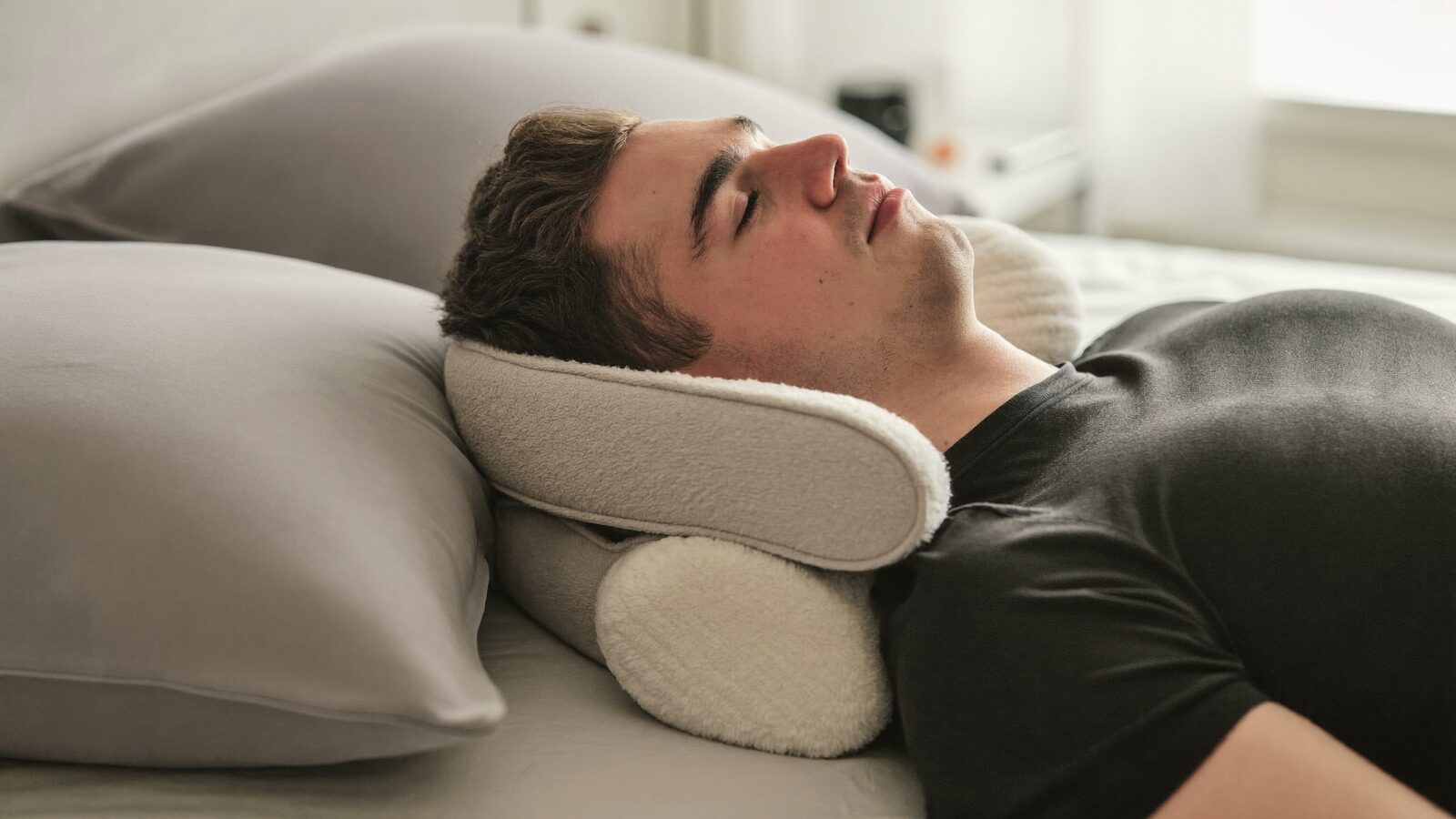
If you are wondering how to sleep after hair transplant surgery, the short answer is on your back, with your head raised at roughly 30 to 45 degrees, for the first five to seven nights. That position keeps the newly placed grafts away from the pillow and lets swelling drain downward instead of settling in your forehead and around your eyes.
Most people can return to side sleeping after about 7 to 10 nights, once the grafts are anchored and the crusts have lifted. Below is a practical night-by-night plan, the pillow setup that makes it bearable and what to do if you wake up in the wrong position. For everything else about the first months, see our hair transplant recovery guide.
Key takeaways
- Sleep on your back with your head elevated about 30 to 45 degrees for the first five to seven nights after a hair transplant.
- Elevation reduces forehead and eye swelling, which typically peaks around the second to fourth day.
- A travel neck pillow or a recliner helps stop your head from rolling onto the grafts while you sleep.
- Most patients can sleep on their side after about 7 to 10 nights and on their stomach after about two weeks.
- Waking up on your side once rarely ruins grafts, but check for fresh bleeding and send the clinic a photo if you are unsure.
Why does sleep position matter in the first week?
Sleep position matters after a hair transplant because newly placed grafts are held only by a small clot and fresh tissue for the first several days. Friction or pressure from a pillow during those nights can disturb a graft, while lying flat lets fluid pool in the forehead, causing swelling that is uncomfortable and slow to clear.
During the day you can protect your scalp consciously. At night you cannot, and most people shift position many times without knowing it. A setup that holds your head in place does the protecting for you while you sleep.
Whether you had FUE (follicular unit extraction, where follicles are removed one by one from the back and sides) or FUT (follicular unit transplantation, where a thin strip is removed and stitched closed), the recipient area on top is the zone to guard. The donor area at the back tolerates gentle contact with a clean pillow much better, although it may feel tender for a few nights.
The safest position: elevated and on your back
The safest sleeping position after a hair transplant is on your back with your head and upper body raised to roughly 30 to 45 degrees. That angle keeps the hairline and crown off the pillow, uses gravity to move swelling away from the face and makes it harder to roll onto your side during the night.
You can get that angle in a few ways. Some patients stack two or three firm pillows, others use a foam wedge, and many find a recliner chair the easiest option for the first two or three nights because it holds the body in one place. An adjustable bed base works just as well if you already have one.
Lying on your back means the back of your head rests on the pillow. That is expected and generally fine, because the donor area is far more robust than the recipient sites. If your clinic sends you home with a dressing over the donor area, keep it on for the first night as instructed.
If the crown was treated, the plan changes slightly: the crown should not press into the pillow either. A neck pillow worn the normal way, or turned so the U supports the base of the skull, keeps the crown lifted clear.
A night-by-night guide to the first 10 nights
The first 10 nights after a hair transplant fall into three phases: strict elevation while grafts are most fragile, a gradual return toward a flatter position as swelling settles, and a careful return to side sleeping once crusts have lifted. The table below shows a typical pattern for patients whose healing is on track.
| Nights | Position | What is happening | Main focus |
| Nights 1 to 3 | On your back, 30 to 45 degrees, neck pillow or recliner | Grafts are most fragile; some oozing on the pillow is normal | No contact between the recipient area and bedding |
| Nights 4 to 5 | On your back, still elevated | Swelling often peaks and drifts toward the eyes | Keep elevation to help fluid drain |
| Nights 6 to 7 | On your back, slightly lower angle if swelling has gone | Crusts are forming and starting to loosen | Avoid rubbing crusts off on fabric |
| Nights 8 to 10 | Back or gentle side sleeping if your clinic agrees | Most grafts are anchored; crusts lifting | Side sleeping on the donor side, not the hairline |
| Night 14 onward | Normal positions, including stomach | Scalp healed on the surface | Clean pillowcases, no rough fabrics on tender spots |
FUT patients are a common exception. While stitches are in place, usually until day 10 to 14, the incision at the back can feel tight, and some prefer to stay elevated on their back a little longer for comfort.
Pillows, neck pillows and bedding
The right pillows and bedding after a hair transplant are simple: something to hold your angle, a travel neck pillow to stop your head from rolling, and clean covers you do not mind staining. Most patients already own what they need or can buy it before surgery.
- Firm pillows or a foam wedge: Soft pillows compress during the night and let you slide flat. Firm ones hold the angle until morning.
- A U-shaped travel pillow: Worn around the neck, it cradles your head and makes it hard to turn onto your side.
- A towel or disposable pad over the pillow: A little pinkish fluid on the first one or two nights is normal and washes out of a towel more easily than a pillowcase.
- Fresh, smooth pillowcases: Change them every few nights. A satin or tightly woven cotton cover creates less friction on the donor area.
- Light, tucked-in blankets: Loose covers you pull over your head can catch the grafts. Keep the blanket at chest level.
- A pet-free bedroom: A cat or dog that likes your pillow is a real risk for the first week.
Room temperature helps too. On hot, humid Chicago summer nights, a fan or air conditioning keeps you from sweating heavily into the pillow. In winter, dry indoor heat can make the scalp feel itchy, and a small humidifier can make the room more comfortable.
Managing swelling and discomfort at night
Swelling after a hair transplant usually starts on the forehead around the second day, may drift down to the eyes by the third or fourth, and fades within about a week. Sleeping elevated, applying a cold pack to the forehead (never on the grafts) and drinking enough water are the simple tools that keep it under control.
Swelling is caused by the fluid used during local anesthesia and by normal inflammation. It is not dangerous, but it can make the first mornings feel puffy and tight. Patients who sleep flat often wake up with noticeably more swelling around the eyes than those who stay propped up.
Discomfort at night is usually mild. The donor area tends to feel sore or tight rather than painful, and the recipient area can feel tingly or numb. Take only the pain relief your clinic approves, at the times given in your aftercare sheet. If you are curious how most patients describe the sensations, our article on whether a hair transplant hurts walks through each stage.
Itching tip: Itching often starts as crusts form around days 5 to 8. Trim your nails short before surgery and consider soft cotton gloves at night, so that scratching in your sleep cannot dislodge crusts or grafts.
Cutting back on salty food and alcohol for the first few days also helps, since both encourage the body to hold on to fluid.
What should you do if you wake up on your side?
If you wake up on your side after a hair transplant, stay calm and roll back slowly. One accidental turn rarely costs grafts, especially after the first two or three nights. Look in a mirror for fresh bleeding at any site, check the pillow for new spots and send your clinic a photo if anything looks unusual.
A graft that has truly come out usually leaves a small spot of fresh blood at that exact site and may be visible as a tiny piece of tissue on the pillow. Light dried spots on the pillow without fresh bleeding are normal oozing from the first nights, not lost grafts.
If you do see fresh bleeding, press gently next to the area, not on it, with clean gauze and contact the clinic. Our team can look at a photo and tell you whether anything needs to be done. Then adjust your setup: add a firmer pillow, try the neck pillow or move to a recliner for a night or two.
If you had manual FUE, as our FUE hair transplant page describes, the recipient openings are small and grafts tend to settle quickly, which is reassuring after a restless night. The precautions still apply for the full first week.
When can you sleep normally again?
Most patients can sleep normally again about 7 to 10 nights after a hair transplant, starting with side sleeping and moving to stomach sleeping around two weeks. The exact timing depends on how fast the crusts lift, whether stitches are in place and what your clinic advises at your check-in.
Elevation can usually stop once swelling has gone, often around night five to seven. Side sleeping is safest on the side that has no grafts near the pillow, and stomach sleeping waits until the hairline has no crusts left. From about the third week, the scalp is generally comfortable with normal pillows and positions.
Sleep matters for healing in a broader sense, too. Seven or more hours of rest helps your body recover from the procedure day, so it is worth making the first week as calm as possible. If you would like to see what each day of the first two weeks looks like, read our day-by-day recovery guide. At Nova Medical Hair Transplant Chicago, Dr. Otto Placik reviews every plan, and you leave the West Loop clinic with written aftercare that includes sleep instructions. If anything about your sleep setup is unclear, write your questions down and contact the clinic; the team will walk you through it.
Recover With a Clear Plan From Day One
Book a free assessment at our West Loop clinic. You get a graft estimate, a written quote and aftercare instructions that cover every night of the first week.